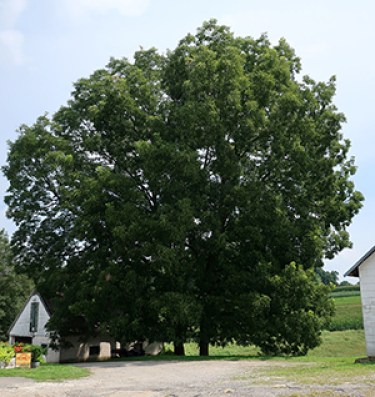
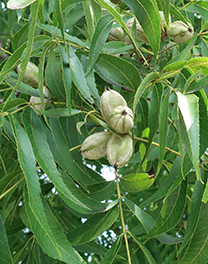
Some weeks ago I wrote about a Horse Chestnut tree I admired. And in the last few weeks another tree caught my eye.
This summer my wife and I have been buying fruits and vegetables from a farm. It’s the “last farm back,” as the handmade signs nailed to trees on the potholed road indicate. There I was drawn to a large tree with an abundance of small nuts. I asked the farm woman what kind of tree it was. “Pecan.” I was amazed. We’re in Maryland. I think of Pecan Trees (Carya illinoinensis) as being southern, as in Texas, Louisiana, Georgia. Yet here it is.
I thought this discovery would make an interesting post—a followup to the Horse Chestnut story. I looked for images of Pecan Trees on stamps, assuming an easy search since trees are a common stamp topic. “No Pecan Tree!”
I did learn that Pecan Trees are native only to the southern U.S. and Mexico. That limited range likely accounts for “No Pecan Tree” stamps. The Pecan is, however, the state tree of Texas (an interesting story), and a difficult tree to propagate. They’re slow to grow and bear nuts, which can have differing characteristics from differing trees, so grafting from mature trees is an obvious strategy for propagation. This grafting was first accomplished in about 1846 by a slave, Antoine, at the Oak Alley Plantation in Louisiana.
 And did you know the pecan isn’t a nut? It’s a member of the hickory genus and is a drupe, a fruit with a single pit surrounded by a husk.

Searching for Pecan Trees on stamps, a few others (trees and stamps) intrigued me. A French Moroccan stamp (above) featured a goat herder. And is that goat attempting to climb a tree in the background? This photograph (Wikimedia) would seem to confirm that possibility.
 A leaf-and-nut-shaped stamp from Brazil (left) honors the Cashew Tree of Pirangi, which entered the Guinness Book of World Records 1994. That single tree covers a mere two acres!
And then there was the comforting scene of a teacher and students planting trees in Togo (below). I commend them.
So, a Pecan Tree wasn’t  there (on stamps), but unexpectedly there is one near me, though without any nesting goats—at least none that I’ve seen.
 Many people, including stamp collectors, find the stamps of the Netherlands a bit too avante-garde, but I’ve always admired how their designers push “the boundaries.” This sheet from 2006 contains five stamps for ordinary mail use within the Netherlands. It would’ve been easier to put multiple copies of the stamp on a sheet side-by-side, and certainly more economical. The Netherlands, however, chose to do more by making a sheet whose title “Beautiful Netherlands” (Mooi Nederland) is composed of perforated letters. And in addition to the playful Eurasian Spoonbill (Platalea leucorodia) with a camera around its neck on each stamp, other images of the wildlife and natural beauty of


 It’s been almost two months since my last post. With the Corona Virus pandemic necessitating staying at home as much as possible, you’d think I’d be posting more. No excuses.
 For me, being outside is a good antidote to the claustrophobic feelings that so easily take hold these days. Fortunately, across the street from my home are the playing fields for two schools located side-by-side on a large tract of land that was once an “estate.” The trees there always lift my spirits. There are many beautiful mature species. And I’m fascinated by so many differing characteristics.
 My brother occasionally joins me for a walk through these fields, identifing the trees. The one shown here captivated me recently for its sheer grandeur. I wondered what it was. Its leaves looked like those on another tree my brother had identified as a
 the tree in the photograph had leaves in clusters of seven. The Horse Chestnut my brother had pointed out had clusters of five leaves. Researching Horse Chestnut trees I discovered that they come in both clusters of five and seven leaves, so I believe I’ve now identified this tree.
 looks foreboding. However, the inner brown nut is quite beautiful, but I learned that it’s not for consumption.
 some of those stamps are shown here. Monaco issued four stamps, each showing a tree detail in one of the four seasons. I can only conclude that others have found this tree as uplifting as I have. Your thoughts?


 The design was derived from the red 2-cent stamp of the Washington Bicentennial Issue of 12 stamps that were issued on January 1. It was established policy to have our first president appear on stamps paying the first class letter postal rate, which on July 6 changed from 2 to 3 cents.
 the same precancel marking but is also a
 A ride on the
 the raised driver’s bench of the electric car (4¢ stamp). I wonder how fast it could travel—probably not fast at all, especially considering the roads of the time. This particular car was passing in front of the Capitol, and I think it would be fantastic to experience Washington at that time.

 Rooting through a box of used U.S. stamps, the cancellations on the three stamps shown here called out to me. The purple Iowa Territory Centennial issue of 1938 is cancelled with the classic numbered shoe-print killer. One look makes it clear why this cancel is called a killer. The barred elliptical mark cancel was invented by John Goldsborough of Philadelphia, and his device, first used in 1875, became the most widely used in the U.S. It’s actually one part of a duplex cancel with part of the circle defining the other portion of the cancel seen on the left side of the stamp. That circle contained the name of the post office where the stamp was cancelled as well as the date. The information is too light to see clearly here, but for me the visual appeal is the powerful black shoe-print killer overlaying the deep purple stamp.
 was the green 1951 Centennial of the Settlement of Nevada stamp. The cancel doesn’t have the visual appeal of the Iowa Centennial stamp, but the slogan is spot-on appropriate for the scene that includes forested mountains in a rugged western landscape: “Remember Only you can PREVENT FOREST FIRES.” That slogan was adopted by the Smokey Bear campaign in 1947 and continued more than five decades.
 Finally, there’s the 2¢postage due stamp from the 1984-95 Bureau of Engraving and Printing series. The strong PHILADELPHIA PA precancel overlaying the rich intricate claret design is for me a thing of beauty. Though the stamp is nicked along the top edge, it’s the visual power of the stamp/cancel combination I find so satisfying.

 It would seem ludicrous that postage stamps could be the antidote, but I’ve written previously about their uplifting power (February 5, 2019, December 13, 2018).
 The prescription I’m benefiting from now is a regimen of children’s art on stamps. Children are far less tethered to cares of life than those of us who have lived the years. Children live their dreams–in color, in joy, in exuberance, in faith and
 belief, and in knowing.
 no effectiveness expiration date. They are, however, “Best used today…and regularly in the future.” The children were charged with imaging the coming millennium. Their visions are awash in color and vitality.
 From early in 1921 to late in 1923 Germany experienced one of the worst periods of inflation in history. For example, to mail a postcard locally at the beginning of 1921 the postage required was 30 pfennig. In December of 1923 the cost to mail that same postcard was 16 billion marks.
 on stamps has also always fascinated me. The combination of the repeated numeral “5” and the column numerals (9, 2, 3, 4) from the stamp sheets shown in the close-up creates a striking visual for me.


 In the past few years, I’ve found Senefelder in two interesting places, my hometown of Baltimore and in Mexico City. While walking in the old part of Mexico City I noticed two busts high on the façade of a building. Even from afar I could identify Gutenberg, and with the help of my camera’s zoom I saw that the other bust was that of Senefelder. Obviously this building at one time had been occupied by a lithographic printer.
 Back in Baltimore, the buildings once occupied by the lithographic printing firm of
 The firm, founded in 1835, occupied the site from 1902-1981 and was one of the world’s most prolific lithographic printers. It specialized in high-quality sophisticated work, including maps influential in settling the west and establishing national boundaries, e.g., maps for the joint commission determining the boundary between the United States and Canada. Above the entrance to the main Hoen building are symbols relating to Senefelder and the lithography process as well as the Latin words, “Saxa Loquuntur.” (The Stones Speak).

